 Hans Rustad
 En internasjonal jihad-milits har overtatt en tredel av Mali, og innført et regime som kan minne om en blanding av Røde Khmer og Taliban.
Folk stanses for bagateller eller rent nonsens, og mishandles på åpen gate. Kvinner er særlig utsatt.
Maliere har flyktet i tusentalls over grensen til Mauritania der de lever i kummerlige kår i grensebyen Mbera.
Det hele begynte med at en militærjunta styrtet regjeringen i landet, samtidig som tuaregene gjorde opprør i nord, sammen med en islamistisk milits. Opprørerne vant frem, men tuaregene ble fortrengt og overkjørt av Ansar Dine, som er alliert med Al Qaida. I deres kjølvann fulgte en strøm av internasjonale jihadister, og det er disse som nå har innført en drakonisk vilkårlighet i Timbuktus gater.
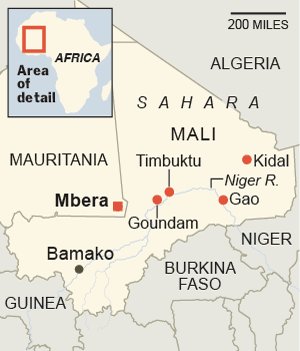
Refugees from such places as Timbuktu, Goundam, Gao and Kidal described witnessing repeated whippings, beatings and other punishments in the streets, ostensibly for having violated strict Islamic law, and some of those who fled said they had been subjected to this harsh justice themselves.
“They said: ‘You are thieves. Why are you out walking at this hour?’ ” Mohamed ag el-Hadj, a 27-year-old former soldier in the Malian Army recalled. He and a friend out for a stroll at 7 in the evening found themselves surrounded by two carloads of well-armed men. The men tied the friends’ arms behind their backs, bound them to a tree and forced them to kneel, bending forward, for the evening. In the morning, “everything was swollen.”
“It was scary,” Mr. Hadj recalled. “They insulted me, called me a savage, an unbeliever.”
When they found a cigarette pack in his shirt pocket, they beat him about the face. “For nothing,” the young man said. “These are their punishments.”
Flyktninger forteller at jihad-militsen består av mennesker av alle tungemål og nasjonaliterer. Det er mange arabere, folk fra Pakistan og Nigeria. Deres manglende tilhørighet gjør at de letter benytter vold mot lokalbefolkningen.
Timbuktu er kjent for noen spesielle gravmæler over hellige menn innen den sufi-retning av islam som finnes i Mali. Men dette er ren vantro i jihadistenes øyne og de har begynt å rive gravmælene som står på Unescos liste over verdensarven.
The Islamists in Timbuktu have destroyed at least a half-dozen venerable above-ground tombs of holy men revered in the ancient city, proclaiming them contrary to Shariah, a legal code based on Islam. The destruction provoked outrage among the citizens and in international organizations. “The day they destroyed the mausoleums, they put sentinels everywhere,” said Hassan ag Sidi, a refugee.
Ali ag Diaba, a traveling musician who fled northern Mali last weekend, said he witnessed citizens being whipped and undressed in the streets of Goundam by the Islamists, who are taken aback by the Malians’ Sufi sect. Many Malians follow a line of belief that posits a more mystical, personal relation with the deity. “They persecute and torture people, under the guise of a false religion,” he said.
Speaking in the shade of a tent, he explained that “When they beat people and others approach” to protest, the Islamists “fire in the air to disperse them.”
Tuaregene er blitt skviset ut. Det var de som startet opprøret, nå er de kuet. Jihadistene er færre, men har bedre våpen.
Amerikanerne og vestlige regjeringer frykter at det nordlige Mali kan bli et nytt Afghanistan; et sted hvor internasjonal terror finner et fristed. Med Boko Haram i Nigeria og Al Shabaab i Somalia er det et lite fristende scenario.
The Tuareg rebels, largely armed by the remnants of deposed Libyan leader Col. Muammar el-Qaddafi’s arsenal, have since been pushed out by their onetime allies, the Islamists, proving no match for the firepower and determination of the jihadist fighters who now reign uncontested over northern Mali. Some of those Islamists are homegrown members of Ansar Dine, a group that has been supported by Al Qaeda, experts say. Others are believed to be part of Al Qaeda in the Islamic Maghreb, an affiliate known by the initials A.Q.I.M. that has a presence throughout the Sahel.
“A.Q.I.M. is composed of people from all over the world,” said a Tuareg leader in the refugee camp here, Mohamed Toutta. “We can’t fight the whole world.”
His son Mohamed, a soldier in the Tuareg M.N.L.A. army, said the Islamists were fewer in number, but better armed.
Sidati ag Mohamed, who once worked in Timbuktu’s tourism industry, said: “We don’t know these people who have come. There are a lot of Arabs and blacks from somewhere else. It’s like the United Nations. The M.N.L.A. can’t defend us.”