 Hans Rustad
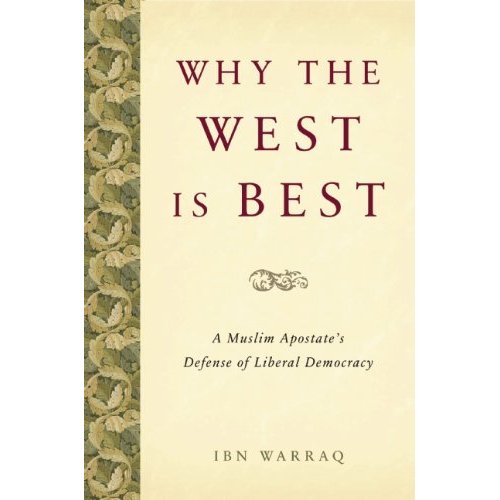
 Ibn Warraq er ute med en ny bok – Why the West is Best: A Muslim Apostate’s Defense of Liberal Democracy.
Den anmeldes av Rebecca Bynum i The New English Review.
Warraq begins by taking on the attitude embodied in a flippant remark made by Mahatma Gandhi, who when asked what he thought of British civilization, replied that he thought it was «a good idea.» To Warraq, these words reveal “ingratitude, hypocrisy, arrogance and incomprehension” which characterizes fashionable anti-Western thought the world over. It was, after all, those evil British colonialists who studied and translated ancient Hindu manuscripts and who preserved their crumbling monuments, essentially restoring India’s history to the Indian people. And by establishing British law and administration (along with the unifying English language), those same terrible colonialists laid the groundwork for India’s economic success today.
Selvpisking er en øvelse Vesten har lært seg. Den bygger på skyldfølelse og har blitt en Ersatz-religion: «frelse» gjennom underkastelse og ydmykelse. Men det er en falsk ydmykhet.
Et annet eksempel på at Vesten har lært seg å benytte dobbeltstandarder, ikke til å fremheve seg selv, med nedvurdre seg selv, er slavehandelen.
Warraq spends a good deal of time on the history of slavery and its eradication in the Western world as an example of cultural self-criticism and moral advancement. In doing so, he puts the Atlantic slave trade (the sole object of Western focus) into a broader perspective and context in which Arab slave traders often financed by Indian merchants bought and sold Africans who were initially enslaved by their fellow Africans. Plus, he covers the period when Arab raiders captured and enslaved over a million white Christians from coastal settlements all over Europe and even the British Isles. He points out that Islam to this day still sanctions and regulates slavery even if its practice has been lessened in the modern world. Racist attitudes of Arabs are still quite prevalent as we have seen with the massacre of blacks during the Libyan liberation and the mistreatment of foreign workers in Muslim countries generally is profoundly shocking to Western sensibilities.
Vesten har mye å være stolt av. Det mest opplagte legger vi ikke merke til, eller forstår vi ikke å verdsette.
He relates a particularly poignant anecdote about an Iraqi friend of his, Dr. W. Ali, whom Warraq discovered photographing the racks of magazines in a New York Barnes and Noble bookstore. The number and variety of the magazines was overwhelming to Dr. Ali, who, realized the amazing societal dynamism required on the part of readers and publishers alike to produce such an incredible number of periodicals specializing in every conceivable subject. In the end, Warraq’s friend was overcome with melancholy.
“It was a shocking revelation to Dr. Ali, who by his own description had lived a constricted life, with leisure activities limited to discussing the latest conspiracy theory while drinking coffee on the streets of Baghdad. It was a sudden realization that not only had a large part of his life perhaps been wasted, but his country had failed to create the necessary conditions – the political and social structures, the principles and values – for such diverse activities to flourish.”
Ytringsfriheten er helt fundamental for forståelsen av vestlig dynamikk og frihet. Dette har Warraq forstått til fulle, og boken er en hyllest til ytringsfrihet.
Here is the central theme: Western superiority in relation to the Islamic world in ingenuity, morality, technological and cultural achievement is the direct result of freedom of thought. The ability to examine, criticize and adjust in an endless cycle, both individually and en masse, is crucial to progress. A culture which stifles curiosity, forbids cultural or religious criticism and requires all individual and social adjustment to be toward conformity to stagnant cultural forms will inevitably fossilize. This is seen in numerous ways. The numbers of books printed in the Muslim world is miniscule in comparison with the huge output of the West. And while there is no Islamic objection to scientific or technological advance per se, the Muslim contribution to that advancement is practically non-existent.
Men Bynum mener Warraq går glipp av noe fordi han ikke forstår kristendommens betydning. Derfor forstår han heller ikke hvordan de siste tiårs kommersiell hedonisme og permissiveness – normoppløsning og meg-kultur, har endret Vesten og lagt inn en ettergivende, kravmentalitet, kamuflert som rettigheter. Det er en kultur uten plikt og den selvoppfofrelsen som kristen kultur innga folk fra barnsben av. Akkurat dette kulturelle forfallet har ikke Warraq helt forstått, og han idylliserer et New York som ikke lenger eksisterer, mener Bynum.
Warraq gikk fra islam og ble ateist, det er forståelig at han ikke er seg bevisst kristendommens betydning og har vendt seg mot all religion. Like fullt er sammenhengen mellom kristendom og frihet klar, skriver Bynum.
License parading as liberty
Can anyone doubt the life of modern man is floundering after having purposely cut his moral lifeline? One might further assert that freedom cannot be separated from the self control that religion confers and that license parading as liberty is always and has ever been the forerunner of abject bondage. For if man cannot control himself inwardly, he will be forced to turn to the state (or mosque) for social control and immorality becomes transformed into illegality – the ultimate removal of individual freedom – a freedom that God himself stands back and allows, even if that means the temporary flourishing of evil. Even during times of moral confusion, man must be free to choose to move toward Love, Truth, Goodness and Beauty or to reject those values, otherwise life would hold no meaning.
The Western political ideal rests directly on the moral foundation of a Hellenized Christianity – that free will is God’s gift to man. Man is free to choose between righteousness and sin and therefore what God has given, no individual or system of government may take away without becoming an unjust oppressor. The Western conception of justice allows that if any system of government presumes to remove the freedom God has given to man, that system may be justly overthrown and replaced by a government that is dedicated to preserving man’s freedom.
The Western state exists to serve man. Man does not exist to serve the state. This primary political concept did not spring from pagan Rome or Greece. Nor could the pagans, with their overwhelming sense of tragic fatalism (or “glorious sadness” as David Bentley Hart describes it) ever have conceived of the pursuit of happiness as a worthy goal of civilization. Nor did the rationalism of the Enlightenment give rise to the concept of equality before the law. These concepts are only found in the deeper Christian strata of our civilization. Indeed it is the Christian conception of man’s immortality and his relation to God as his son (not servant of slave) that Warraq unfortunately omits, but which is essential to a profound understanding of the Western conception of reality and the ordering of the world.
Why the West is Best
a review by Rebecca Bynum
bestill boken gjennom documents bokkarrusell, og document får en liten godtgjørelse av amazon